
Three checks you can run on your own pages right now
Answer checkTake one answer an AI gave a buyer and turn it into one change on one of your pages.Passage checkSee whether your own passages still make sense once a machine lifts them out of the page.Evidence checkFind out which passage on your page carries a claim you want to make, and which one says the opposite.On this page
- What it is
- Search Result Optimization is the work that starts where the result page stops: being the source an answer is built from.
- The problem until now
- A ranking was the goal, so nobody could tell whether the answer shown above it was true, whose words it used, or what it left out.
- What you can do from here
- You can run the tests on this site on your own pages today, and read every claim here against the source it comes from.
Contents 21
184 pages, 186 tests you can run yourself, 134 sentences quoted word for word from outside the result pages, each one linked to the exact place it stands. Every table names free means. Nothing here asks you to believe it.
new De-trivializing A question can name a place, a period and a purpose. Only the place reaches the result page. What that means for the way you write yours.
Try this first
Three tests, about five minutes. They show what a directory of links cannot.
Tests on this page you have run: 0 of 3. The count stays in this browser only.
Test: Search Result Optimization
- Search your most important buyer question on Google.
- Note what you got, before you open anything else.
- Think: did you get the answer without a visit, and whose words were used?
Whether the search ended before your page.
Test
- Ask ChatGPT what your company sells and what it charges.
- Note the answer in your own words.
- Think: which sentence is false, and where on your site should it have been settled?
What an assistant tells buyers about you.
Test
- Open your most important page and write down the one fact it adds that no other page carries.
- Put it aside for a moment.
- Think: if you cannot name it, why should a system cite the page?
The reason to be quoted at all.
A page one ranking can be a beautiful storefront on a street where no one ever goes.
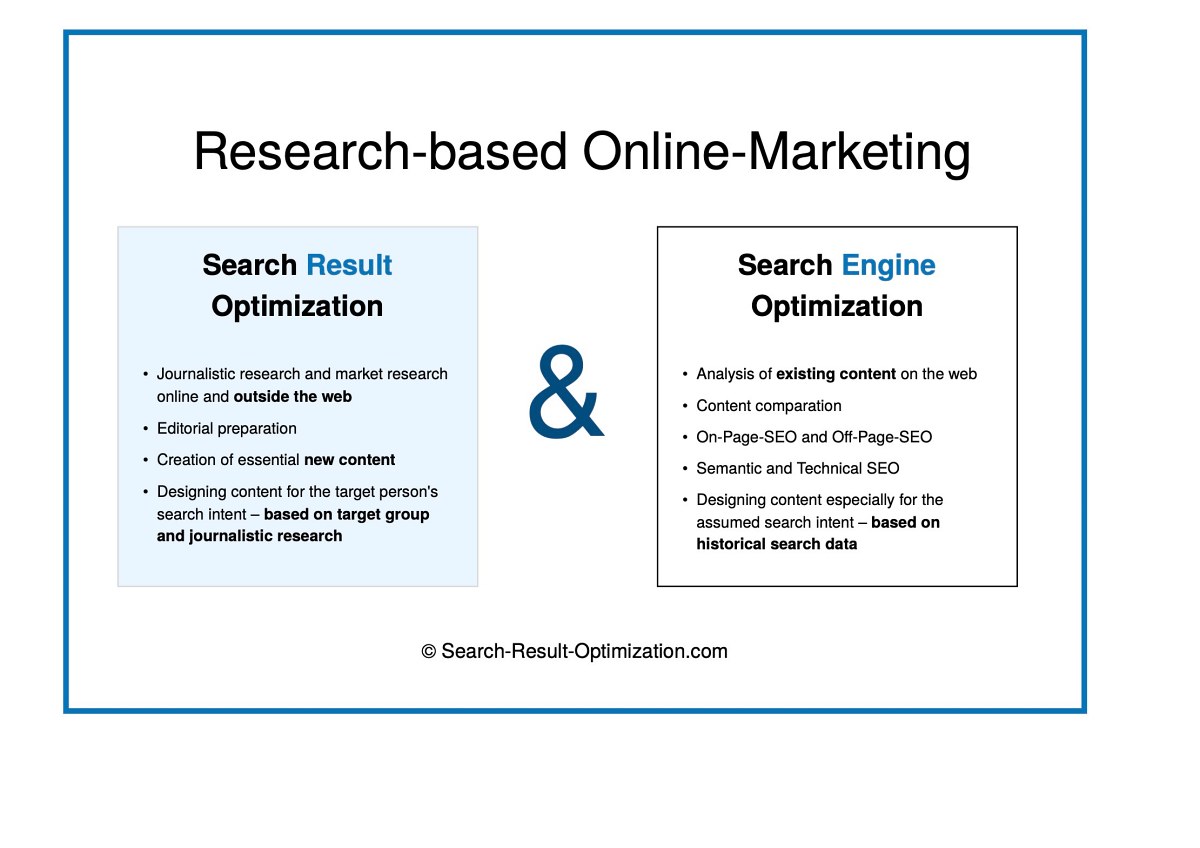
This is the next higher version of SEO. You can imagine the search engine results pages as Google's shop windows. If the title and the description carry relevant content, the website gets search engine traffic. The result pages are built in real time, depending on the search query and on the intent behind the words.
Search results are aimed at the end of the search. Knowledge begins after that point. This site works on the distance between the two.
If originality decided the top of page one, the first and the third result would not score the same. They do.
| Position on Google | Median originality score | Share graded mostly shared |
|---|---|---|
| Position 1 | 52 / 100 | 24 % |
| Position 3 | 52 / 100 | 24 % |
| Positions 4 to 10 | – | 37 to 40 % |
150 pages across 50 search queries in 10 verticals, scored for semantic originality. Study by On-Page.ai, published through Similarweb, June 2026. The median top-3 page carries four figures that appear on no competing page.
Eleven fields for Search Result Optimization


Information retrieval
Information retrieval built the machine that marketing talks about without reading its manual.

Human-computer interaction
The result page is an interface. Most marketing treats it as a leaderboard.


SEO: Classic SEO, Semantic SEO and Supervised Search
The older discipline, and what changed once the answer arrived above the results.
- Why SEO is important in 2026
- Backlinks as a ranking factor in 2026
- Most common misunderstandings about SEO
- User intent and the information need behind it
- What makes the best search result
- E-E-A-T
- Why a website has to be user-friendly
- Why page speed matters for SEO and for visitors
- Do you need an SEO agency?
- Presupposition in search queries
- Relevance theory and what relevance means in search
- LSI keywords, an SEO hallucination
- Conversational implicature: what queries and pages mean without saying it
- Speech act theory: what a query does
- Communicative intent: the goal behind every signal, from gesture to query
- Intent collapse: when answers merge what people want
- How to optimize search engine results

Supervised Search: when the publisher supervises the last stretch of a search
Supervised Search: the page asks what brought the visitor, and the search reaches its real goal.

Answer engine optimization
The result page answers the question itself. This is the work of being the source it answers from.

Digital PR: news, opinion, discussion and video are four different assets
Coverage is not one thing. News, opinion, discussion and video are four different assets.

Generative engine optimization
A generative engine writes the answer and names a few sources. This is the work of being named.

Epistemology
Search engines decide what counts as knowing. The field that studies knowing was never asked.

Large language models
A model reads your page, decides what it says, and writes the answer somebody else will read.
Searching on the web and in everyday life, a fundamentally new approach
As long as he lives, man seeks:
- Opportunities
- Solutions
- Entertainment
- Development
- Ways
Searching the Internet is, almost, automated. That is practical. And that is a problem
Search engines algorithmically evaluate what people ask, search, and buy. It is not always possible to extrapolate people's true motives and concerns. So a lot falls by the wayside. People lose themselves early in the illusion that they have already seen everything in the search result list (filter bubble).
The search in everyday life is often limited to a small radius
Whether it is about finding a way out of a personal crisis or about everyday decisions such as “repair or buy new?”, people are satisfied too quickly, and are often dissatisfied with them.
Search Result Optimization is a proposal for industry, sociology and psychology and every person.
Rethink what you have been looking for so far. Always start a new search. You will be surprised.

Enough consensus, plus the part that is missing
Ten results that agree with each other are not ten answers. Search result optimization starts with enough consensus and continues with what the consensus leaves out.
Every subject has a settled core. Covering it is necessary and it takes a few paragraphs. Covering every semantically related term beyond it produces pages that are complete for a machine and exhausting for a person.
The useful work starts after the settled core: the questions that belong to the subject, that people ask, and that the agreed coverage on the first page leaves out.
Eighty-seven subjects are treated here, across eleven fields. Each one states what is settled, then names what is missing from the agreement, then lists the questions people actually arrive with.
Conversion is the goal, and a ranking for its own sake is not
Content has to deliver answers to more than one query. It has to tell the whole solution story, including the effects that follow from the solution.
SEO knowledge is still largely limited to the question of how to rank. In marketing the position that pays is the first place in the relevance set of a target group.
Google ranks content pieces and excerpts, so every piece has to give the reader full orientation:
- Where am I here on this website?
- What do I get here?
- Is this true and complete?

People search for solutions, not for websites
A person wants to get rid of a headache and types headache tablet. The search intent is the tablet. The user intent is the end of the headache. She does not like pills and would prefer acupressure, and she does not yet know that acupressure exists.
Search intent and user intent differ in many cases. That difference is where results get built that surprise somebody.
The project
The personalization of the internet leads to hasty decisions. Small and medium-sized companies without marketing budgets of millions can only win customers with high effort for content development or search engine advertising.
The Search Result Optimization project invites you to put the user and their personal intention at the centre of your own presentation. In principle every company can find a niche with its own portfolio, particularly in local services and in medicine.
It starts where classical search engine optimization ends, beyond marketing that is driven by the result page.
Every page of this project and every connection between them is drawn on the Knowledge graph. It also shows which pages no hub has claimed, which is the part of a site nobody publishes.
One set of pages stands on its own: Structured data, where every claim made for markup is sorted into the ones Google documents and the ones it denies.
I am Johannes Faupel, partner of FFM Coaching Associates in Frankfurt, Germany, Springer author and patent owner of an advanced psychoeducational tool. I work on executive coaching and communication development for demanding subjects, among them patient communication, burnout prevention and the underestimation of the human brain.
Last revised 2026-09-16.